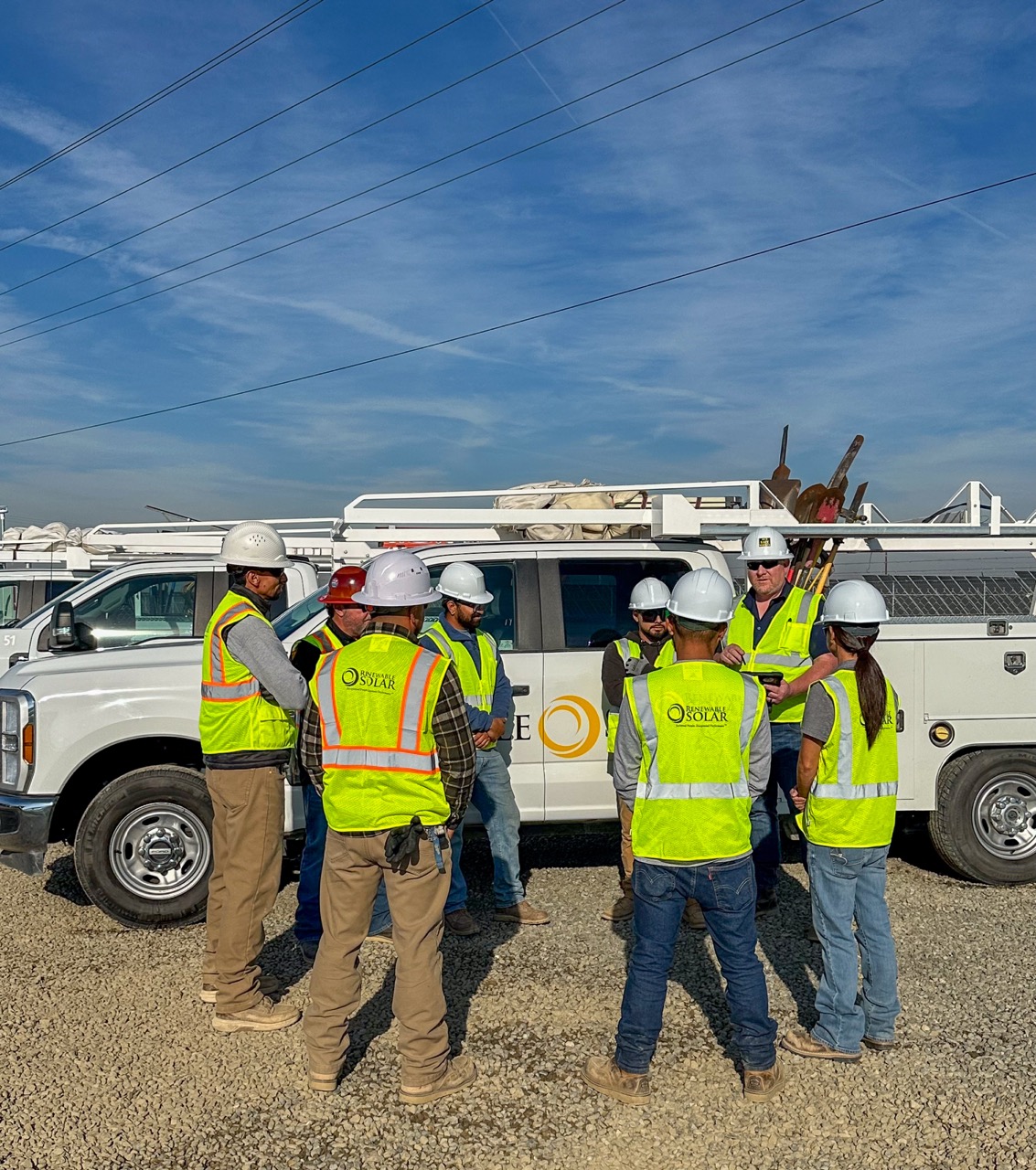


Most people picture a solar installation as a single event: a crew shows up, panels go on a roof or into a field, and power starts flowing. In reality, panel installation is just one phase in a much longer sequence, and often not the longest one. Site development, electrical infrastructure, permitting, and utility interconnection typically take more time and coordination than the visible construction itself.
Understanding what actually happens behind the scenes explains why solar projects are civil and electrical projects first, and solar projects second.
Phase 1: Site Development and Civil Work
Before any equipment is installed, a site has to be physically prepared to support it. For ground-mount systems, this means grading, excavation, and building pads capable of supporting inverters, switchgear, and other heavy electrical equipment. It means trenching to route underground conductors between the array, the equipment pads, and the point of interconnection. On larger commercial and industrial sites, it can also include paving, access roads, and drainage work, none of which involves a single solar panel but all of which determines whether the site is buildable at all.
This civil groundwork is where soil conditions, drainage patterns, and existing underground utilities get identified and addressed. Skipping or rushing this phase is one of the most common sources of downstream delay and cost overrun in construction generally, because problems discovered mid-project (like unsuitable soil or an unmarked utility line) are far more expensive to fix than problems caught during site assessment.
Phase 2: Electrical Infrastructure
Running in parallel with, or immediately following, civil work is the electrical infrastructure that will actually move power. This includes new three-phase service installations, low and medium voltage work, and the switchgear that connects a system safely to a building or to the grid. None of this is solar-specific. It’s the same category of electrical infrastructure work required for any commercial power system, and it has to be engineered to the same codes and utility standards regardless of what’s generating the power.
This is also where a solar project’s timeline gets determined more than anywhere else. The National Renewable Energy Laboratory (NREL), a U.S. Department of Energy national laboratory, has tracked interconnection timelines across thousands of projects nationwide and found that the median timeline for the full utility interconnection process spans 53 business days across all system sizes analyzed. NREL has also found that the review and approval processes tied to the roughly 20,000 distinct permitting jurisdictions and 3,000 utilities across the U.S. can add weeks or months to an installation timeline. None of that time involves a crew on-site installing panels. It’s engineering review, utility coordination, and inspection, almost all of it electrical.
This is also why “soft costs” (everything that isn’t hardware) make up such a large share of total project cost. The Solar Energy Industries Association (SEIA) reports that the soft cost share of total residential system cost has risen from 58 percent in 2014 to roughly 65 percent today, even as total system costs have fallen significantly. Engineering, permitting, and electrical infrastructure aren’t a side expense to a solar project. They are a majority of it.
Phase 3: Solar and Battery Installation
Only after the site is graded, the pads are poured, and the electrical infrastructure is designed does the phase most people associate with “solar installation” actually begin: mounting racking, setting modules, and installing battery storage where applicable.
This phase carries its own regulatory weight. The Occupational Safety and Health Administration (OSHA) classifies new solar installation as construction work, which means workers exposed to fall distances of 6 feet or more must be protected through a guardrail system, a personal fall arrest system, or an equivalent method. Once a system is installed and moves into maintenance, it shifts to general industry standards, where the threshold drops to 4 feet. The distinction matters because it reflects two different risk profiles: installing a system from scratch, and maintaining one that’s already live.
Phase 4: Testing, Commissioning, and Interconnection Approval
A completed installation isn’t an operating one. Before a system can be energized, it has to pass inspection, be tested for compliance with electrical code and utility interconnection standards, and receive formal authorization from the utility, known as Permission to Operate (PTO). Only after PTO is granted can the system legally connect to the grid and begin producing power for use or export.
This final phase is often where projects stall the longest, particularly for larger commercial systems. NREL’s interconnection research notes that nonequipment costs like permitting, inspection, and interconnection remain stubbornly high even as photovoltaic hardware prices have fallen sharply over the past decade, in large part because the process depends on coordination across multiple parties: the installer, the local permitting authority, and the utility, each operating on its own timeline.
Why These Phases Don’t Divide Cleanly
Laid out this way, it’s clear that a solar project is really three overlapping bodies of work: civil site development, electrical infrastructure, and the solar system itself. What’s less obvious is how tightly they depend on each other.
Civil work has to be engineered around the electrical loads it will support. A pad sized incorrectly for the switchgear it’s meant to hold, or a trench routed without accounting for conductor separation requirements, creates rework that ripples into the electrical and installation phases. Electrical infrastructure has to be designed around the site conditions the civil work reveals. Soil composition, grade, and drainage all affect conduit routing and equipment placement. And the solar installation itself can’t proceed safely or on schedule until both the site and the electrical infrastructure underneath it are actually ready.
This is why the handoffs between disciplines, not the disciplines themselves, tend to be where solar projects run into trouble. A civil contractor who doesn’t fully understand the electrical scope, or an electrical contractor brought in after the pads are already poured to the wrong specification, introduces a coordination gap that someone has to close, usually at the cost of schedule, budget, or both.
What This Means for Anyone Planning a Project
For developers, general contractors, and facility owners evaluating a solar project, the practical takeaway is that the panels are the easy part to plan for. The harder questions are about everything underneath them: who is handling site grading and pad construction, who is designing and installing the electrical infrastructure, how the interconnection application will be managed, and how these pieces are being coordinated across what NREL’s own data shows can be a multi-month process even before construction visibly begins.
Asking those questions early, before a contractor is selected, is one of the more reliable ways to avoid the delays and cost surprises that show up later in a project’s timeline. The work that never gets photographed (the grading, the trenching, the switchgear, the interconnection paperwork) is usually the work that determines whether a project comes in on schedule at all.